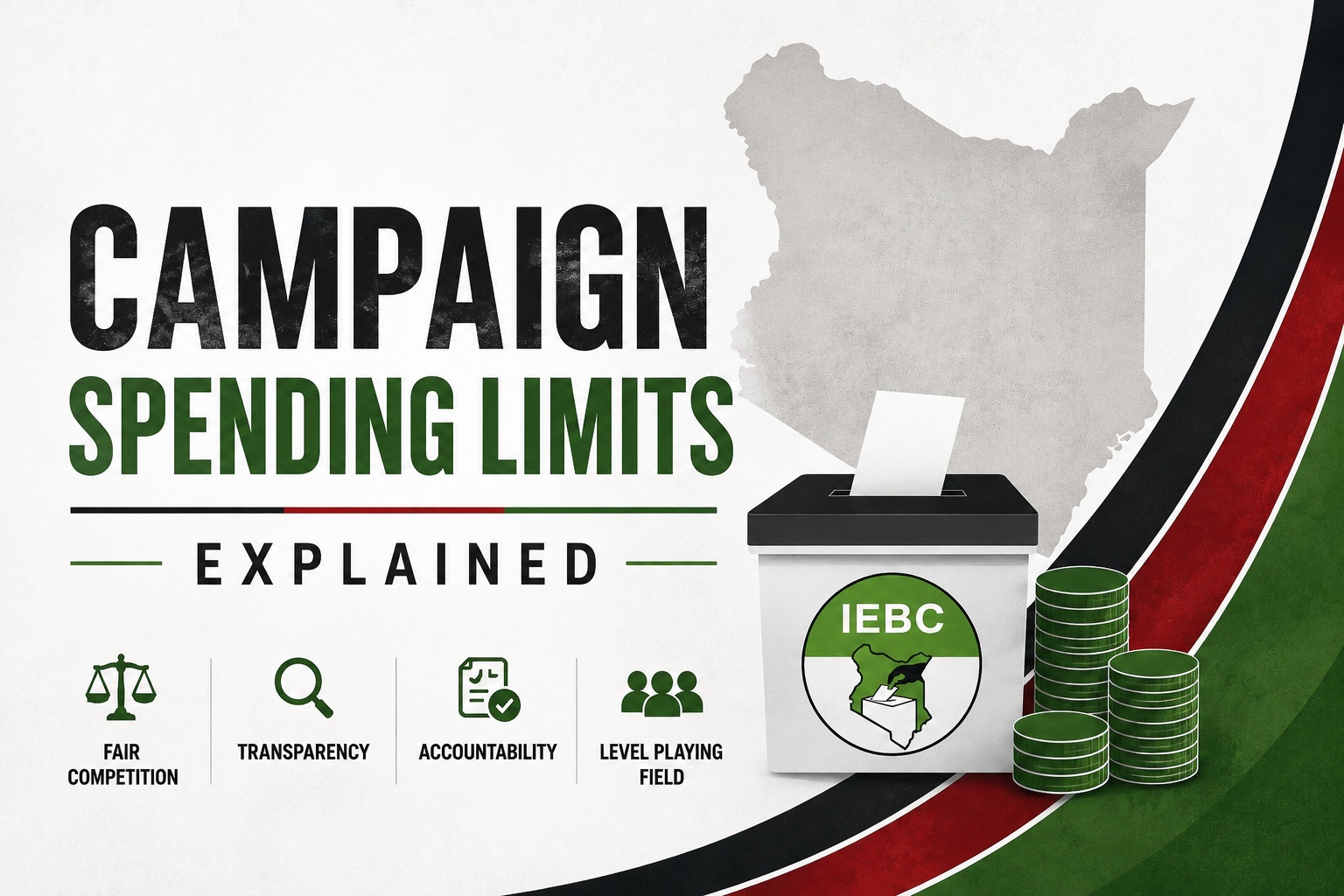
As Kenya heads toward the 2027 General Election, the IEBC has gazetted new campaign spending and contribution limits, setting financial ceilings for presidential, parliamentary, county and ward candidates while introducing rules intended to improve transparency and fairness in electoral competition.
As Kenya enters the final year before the August 2027 General Election, the Independent Electoral and Boundaries Commission (IEBC) has officially published campaign spending limits governing how much candidates and political parties can spend during the election period.
The figures—including a presidential cap of just over Ksh 6.1 billion and a Nairobi County limit of Ksh 181 million—have attracted attention. But behind the numbers are broader questions about electoral fairness, campaign financing, transparency and the influence of money in politics.
Why the Limits Were Set
The main purpose of campaign spending limits is to prevent elections from becoming contests determined largely by wealth. Without spending ceilings, candidates with substantial personal resources or powerful financial backers could dominate campaign visibility, logistics and voter outreach, putting less-resourced candidates at a structural disadvantage.
The limits are therefore intended to create a more level playing field, allowing ideas, organization and voter appeal to play a greater role than the size of a campaign budget.
Read More
The framework also seeks to reduce the distorting influence of money in politics. Large and opaque campaign spending can create risks of vote-buying, clientelism and excessive influence over elected officials. By limiting expenditure and requiring disclosure, the rules seek to reduce opportunities for illicit financing and undue influence.
The limits also promote accountability. Candidates and political parties are required to keep records and report campaign expenditure, allowing the public, media and IEBC to scrutinize how campaign money is raised and spent.
The Legal Grounds
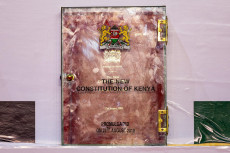
The IEBC’s authority to regulate campaign spending comes from Article 88(4)(i) of the Constitution, which requires the Commission to regulate “the amount of money that may be spent by or on behalf of a candidate or party in respect of any election”.
The Election Campaign Financing Act, 2013, gives effect to this constitutional mandate. Sections 12, 18 and 19 provide for contribution and spending limits, authorized expenditure, record-keeping, disclosure and compliance. Complementary powers are provided under the Independent Electoral and Boundaries Commission Act, 2011.
After years of delayed implementation and legal clarification, the IEBC published Gazette Notice No. 12251 on 7 August 2026, setting out the 2027 contribution and spending limits, the formula used to calculate them and the applicable rules.
What the Rules Set
A presidential candidate may spend up to Ksh 6,112,543,133, while political parties collectively face an overall spending limit of Ksh 24,450,172,531.
County-level limits vary according to population and land area. Nairobi City County has the highest ceiling at Ksh 181,312,885, followed by counties including:
Turkana- Ksh.142,072,389
Marsabit- Ksh.127,022,462
Wajir- Ksh.120,758,077
Kiambu- Ksh.110,961,257
Lamu- Ksh 28.7 million
Tharaka Nithi- Ksh.32,302,217
Elgeyo-Marakwet- Ksh. 35,659,941
Vihiga- Ksh.36,683,540
Nyamira- Ksh.38,115,302
For National Assembly constituencies, North Horr has the highest limit at approximately Ksh 100.4 million, while Wundanyi is among those with the lowest at about Ksh 15.4 million.
At ward level, limits range from approximately Ksh 22.1 million in Turbi Ward, Marsabit, to between Ksh 3.6 million and Ksh 3.8 million in some densely populated urban wards.
Campaign funds may cover venues, advertising, personnel, transport, communication, nomination fees, security, accommodation and other authorized administrative expenses. Contributions from a single source are capped at 20 per cent of the applicable total.
The limits were calculated using a formula weighted approximately 70 per cent for population and 30 per cent for land area. Exceeding the prescribed limit without reporting unforeseeable or exceptional circumstances is an offence punishable by a fine of up to Ksh 2 million, imprisonment for up to five years, or both.
The gazetted framework gives Kenya’s campaign-financing law a more practical foundation. Its real test, however, will come during the campaigns, when rigorous monitoring, timely disclosure and consistent enforcement will determine whether the limits can meaningfully restrain the influence of money in the 2027 election.