-1786628407.jpg)
Homa Bay is emerging as a key battleground in the struggle over Raila Odinga’s political legacy, with Edwin Sifuna and the Linda Mwananchi movement preparing to test ODM’s dominance in its traditional stronghold. The August 16 rally could expose deeper divisions within Luo Nyanza politics and offer an early glimpse into the opposition realignment taking shape ahead of 2027.
The Linda Mwananchi movement, associated with Nairobi Senator Edwin Sifuna, Siaya Governor James Orengo, Embakasi East MP Babu Owino and others, is planning a major rally in Homa Bay County on Sunday 16 August 2026. Organizers describe it as a civic engagement on governance, accountability, the cost of living and citizens’ rights.
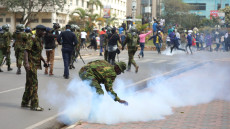
The planned meeting has already raised political temperatures in the county, with concern following allegations from Linda Mwananchi figures that senior leaders, including Homa Bay Governor and ODM national chair Gladys Wanga, Migori Governor Ochilo Ayacko and Homa Bay Town MP Peter Kaluma, plan to mobilize groups to disrupt or invade the meetings.
Wanga has publicly called for calm, saying anyone is free to campaign in Homa Bay. She has also maintained that ODM’s support for the broad-based government arrangement remains unchanged.
A Struggle Over Raila’s Political Legacy
This is more than ordinary political competition. At its heart is a struggle over the political inheritance of the late Raila Odinga’s Luo Nyanza base and the future of the Orange Democratic Movement after his passing away.
Read More
The demise of a radical leader can expose factional splits previously held together by personal authority. The split into Linda Mwananchi and Ground mirrors earlier Kenyan experiences within FORD-Kenya following the passig of Jaramogi Oginga Odinga.
Research on party institutionalization shows that parties with weak internal structures often depend heavily on the personal networks of their founders. When those networks weaken or disappear, competition grows over the party name, grassroots machinery and the claim to represent the founder’s political legacy.
Sifuna’s Insider-Outsider Advantage
Sifuna’s position as both an insider and outsider makes the challenge more significant. He served for years as ODM’s Secretary-General and openly opposed the direction the party took after Raila’s death. That gives him a credible alternative claim to the opposition identity associated with the party’s history.
Taking that message directly into Homa Bay challenges the local leadership’s ability to project a united political front. It also creates the possibility that grassroots dissatisfaction, reflected in the TIFA numbers, could develop into an organized political force.
Broader Implications for 2027 Realignment
From a research perspective, the Homa Bay episode brings several political processes together:
Opposition realignment under pressure: When the main opposition party becomes partly incorporated into government, space opens for a “third force” or a more uncompromising opposition movement. Linda Mwananchi’s crowd mobilization, independent fundraising and expansion beyond traditional ODM areas fit this pattern.
Symbolic politics of disruption: Allegations of planned disruption can raise the political cost of entry for a challenger while portraying that challenger as an outsider trespassing on protected political territory. It is a familiar tactic in the defense of political strongholds.
Limits of formal expulsion: Being removed from a party position does not always end one’s ability to rally and mobilize unless the person loses popular legitimacy and organizational strength. One’s party status and influence are hence structurally different issues to be addressed rather than personal issues.
Wanga’s public position—welcoming the constitutional right to campaign while maintaining that the region’s political choice has already been made—seeks to balance democratic norms with the defense of ODM’s political territory. Orengo and other Linda Mwananchi leaders, meanwhile, have maintained that threats will not stop them.
Homa Bay as the Test
What happens at the 16 August gathering, how security agencies respond, and how local leaders and residents react afterwards will offer a clearer picture of just how durable the post-Raila settlement within ODM really is.
In the end, Sifuna’s presence in Homa Bay is being treated as a threat not mainly because of his current formal party position, but because it tests whether mainstream ODM leadership can maintain an exclusive claim to Raila’s political legacy in the face of a well-resourced, poll-supported alternative that rejects the broad-based arrangement.
That contest brings together three forces shaping Kenya’s politics ahead of 2027: a succession struggle, the defense of political territory and an opposition realignment that is still far from settled.