

- Through a statement on March 3, 2026, the CS Energy says that imports are already scheduled through the end of April 2026, securing continuity of supply despite global volatility.
Energy and Petroleum Cabinet Secretary (CS) Opiyo Wandayi has assured Kenyans that the country holds sufficient petroleum stocks to meet both domestic and regional demand.
Through a statement on March 3, 2026, the CS says that imports are already scheduled through the end of April 2026, securing continuity of supply despite global volatility.
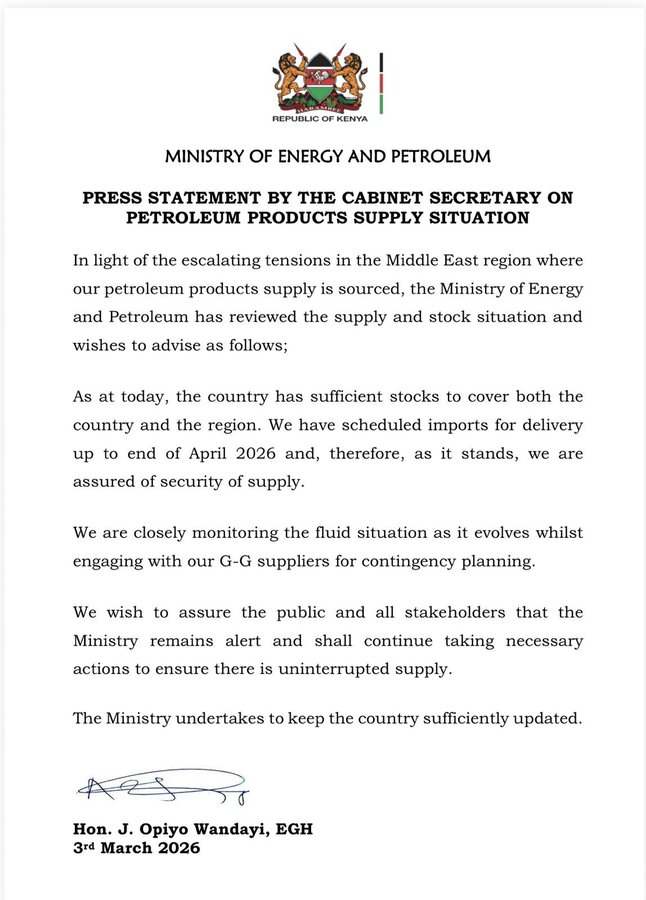
“We are closely monitoring the fluid situation as it evolves while engaging with our G‑to‑G suppliers for contingency planning,” the Ministry stated.
Read More
The Ministry has pledged to remain alert and to take all necessary actions to guarantee uninterrupted supply, promising regular updates to the public and stakeholders.
Government‑to‑Government Deal Anchors Stability
Kenya’s oil supply currently rests on a Government‑to‑Government (G‑to‑G) agreement with the Middle East, designed to stabilize the shilling by easing immediate dollar demand. Under the extended deal, Kenya imports refined products from three major Gulf state‑owned firms:
Saudi Aramco (Saudi Arabia), Abu Dhabi National Oil Company (ADNOC) (UAE) and Emirates National Oil Company (ENOC) (UAE).
The agreement, recently extended, now runs through 2027.
Strait of Hormuz Risks
Nearly all of Kenya’s oil imports transit through the Strait of Hormuz, a narrow waterway that carries about 20% of global oil. Rising tensions involving Iran have raised fears of disruption at this chokepoint.
While physical supply remains stable, Brent crude prices have surged past $80 per barrel, driven by Middle East conflicts. Freight and insurance costs for supertankers have also spiked, raising concerns that local pump prices could eventually feel the pressure.
Currently, the Middle East is experiencing a direct U.S.–Israel vs. Iran confrontation, spilling over into Gulf states with missile strikes, drone attacks, airspace closures, and threats to oil shipping routes. The crisis is both a security emergency and an economic shock, with ripple effects reaching far beyond the region.
Stay connected with us on WhatsApp and Facebook for instant updates and breaking news as it happens.




-1772457721-md.png)





-1772457721-sm.png)