
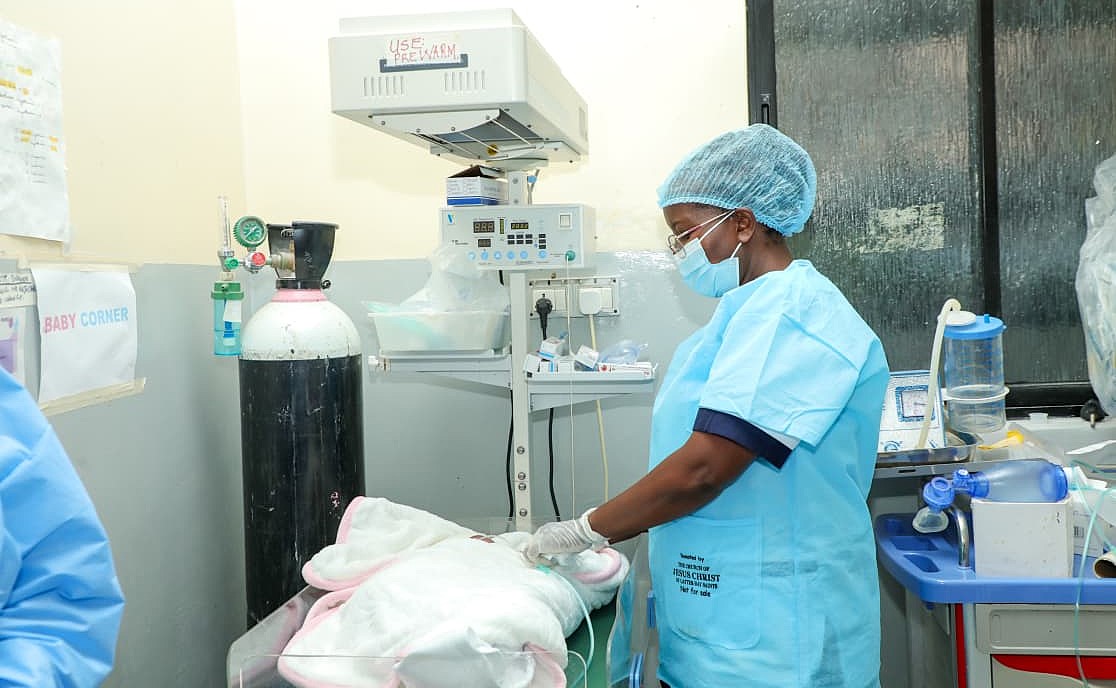
- At Nakuru County Teaching and Referral Hospital’s Margaret Kenyatta Mother and Baby Wing, safe delivery is more than a surgical act—it is a coordinated journey of teamwork, vigilance, and compassion. From nurses monitoring blood pressure to anesthetists confirming readiness, and surgeons relying on the obstetric safety checklist, every step is designed to minimize risk and ensure mothers and babies leave theatre healthy.
It is a busy afternoon at Margaret Kenyatta Mother and baby Wing theatre, at Nakuru County Teaching and Referral Hospital (NCTRH). In the waiting lobby, expectant mothers and their relative wait patiently to be served, they all look optimistic and looking forward to holding their bundle of joy oblivious of the rigorous process that it takes a team of medical personnel to actualize it.
Dr Emanuel Chiro, a resident medical officer at the hospital has just completed a successful caesarian section among many that are conducted in a day. He says each successful procedure is as a result of a long process that begins way before the expectant mother is laid on the operating table.
“It’s a whole journey, starting from conception to the time the baby is delivered and followed up, I can’t say that the journey starts here in theatre this is just the tail end,” Dr. Chiro says.
Dr Chiro says that several decisions have to be made by nurses that includes checking blood pressure, and review of the lab results. Surgery is often determined by conditions like pre-eclampsia which causes dangerous spike in blood pressure in pregnant women.
While giving an example of a just completed caesarian surgery that he led, he says the mother had a severe pre-eclampsia, this combined by the fact that the mother had undergone one before could only mean that normal delivery was not safe for her.
Read More
“Our job is to see a healthy baby that comes out of the womb, our joy is getting a baby who is healthy, who would otherwise have been subjected to poor outcomes,” Dr. Chiro notes.
A mother’s safe delivery is not a single person’s decision, it is a whole system premised centrally on the surgical safety checklist, a procedure that ensures all details, starting from the identity of the patient, are confirmed before, during, and after the surgical procedure.
Dr Chiro says that the checklist is as important as the scalpel used during surgery. This is because it minimizes avoidable mistakes and helps proper decision making incase of a complication.
Dr Dorcas Komen, theatre in charge at Nakuru County Teaching and Referral Hospital (NCTRH) and her colleagues are seriously implementing the Obstetric safe surgery. Among other things the checklist is aimed at reducing surgical site infection (SSI) and improve recovery of mothers undergoing caesarian section.
“This obstetric safe surgery project has reduced the rate of surgical site infections, we track patients after discharge, and the difference is clear,” Komen explains.
The checklist involves vaginal cleansing before surgery, refined skin preparation procedure, and the use of antibiotics. Instead of general antibiotic use, under the checklist medication is administered based on distinct indications, or as prophylaxis 30 to 60 minutes before surgery begins.

Komen stresses that the safety doesn’t end after a mother leaves the hospital. The checklist requires that mothers be followed up seven days after surgery, done through phone calls to evaluate the wound condition, discharge, or pain. Incase of any sign of infection on the surgery site, patients are referred to the nearest health facility.
“We call patients after seven days to check the state of the incision, if there is pain or discharge, we advise them to report immediately,” says Komen
She says that the checklist compliance has steadily improved maternal care, thanks to mentorship, file reviews and regular procedure adherence audit. Even when there are staff shortages and there are heavy caseloads, the team of responsible doctors still stick to the checklist because the stakes are too high to ignore it.
Irene Chepchirchir an anesthetist at the hospital is also part of the team implementing the checklist. She engages with it from the first step.
“Before induction, we must confirm the patient, the procedure, our machines, monitors, and medications. The checklist reviews if you are truly ready before you start,” Chepchirchir explains.
Her work involves checking oxygen saturation monitors, to ensuring that emergency drugs and blood products are readily available, anesthesia preparation is thorough. Communication is at the centre of operationalizing the checklist, therefore, all the team members must attentively listen, and align everything before the first cut is made by the doctor.
She says this shared responsibility in operationalizing the checklist has greatly transformed teamwork, and helped them work homogeneously. This is because every team member understands the process, and their role in it.
"This is crucial because in case of emergencies where seconds matter, understanding and implementing shared responsibility correctly per the checklist saves lives," she says.
Stay connected with us on WhatsApp and Facebook for instant updates and breaking news as it happens.


-1769507417-md.png)

-1769442279-md.png)


-1769507417-sm.png)