- Its story begins almost a century ago. Incorporated in 1923, the Kenya Farmers’ Association was created to serve farmers’ needs; marketing produce, supplying fertilisers, seeds, chemicals, and machinery. As agriculture expanded across the Rift Valley, KFA grew with it, establishing branches countrywide.
For anyone living in Nakuru, the KFA is so familiar it hardly needs an introduction. For newcomers, it quickly becomes the city’s first landmark. Soon enough, you’ll understand how the name came to be, and why it still echoes through Nakuru’s streets today.
The first stop for many matatu passengers from Kabarak, London, or Kiamunyi Estate is KFA — a landmark roundabout where they alight and step straight into Nakuru’s bustle.
Located along the main Nakuru–Eldoret highway, near Naivas Supermarket and KFC, the KFA Roundabout acts as a central hub connecting key areas. Just 4 km north of Lake Nakuru, it anchors the gateway into the CBD, surrounded by shops, offices, transport stops, and civic landmarks like Nyayo Gardens, Afraha Stadium, and the railway station.
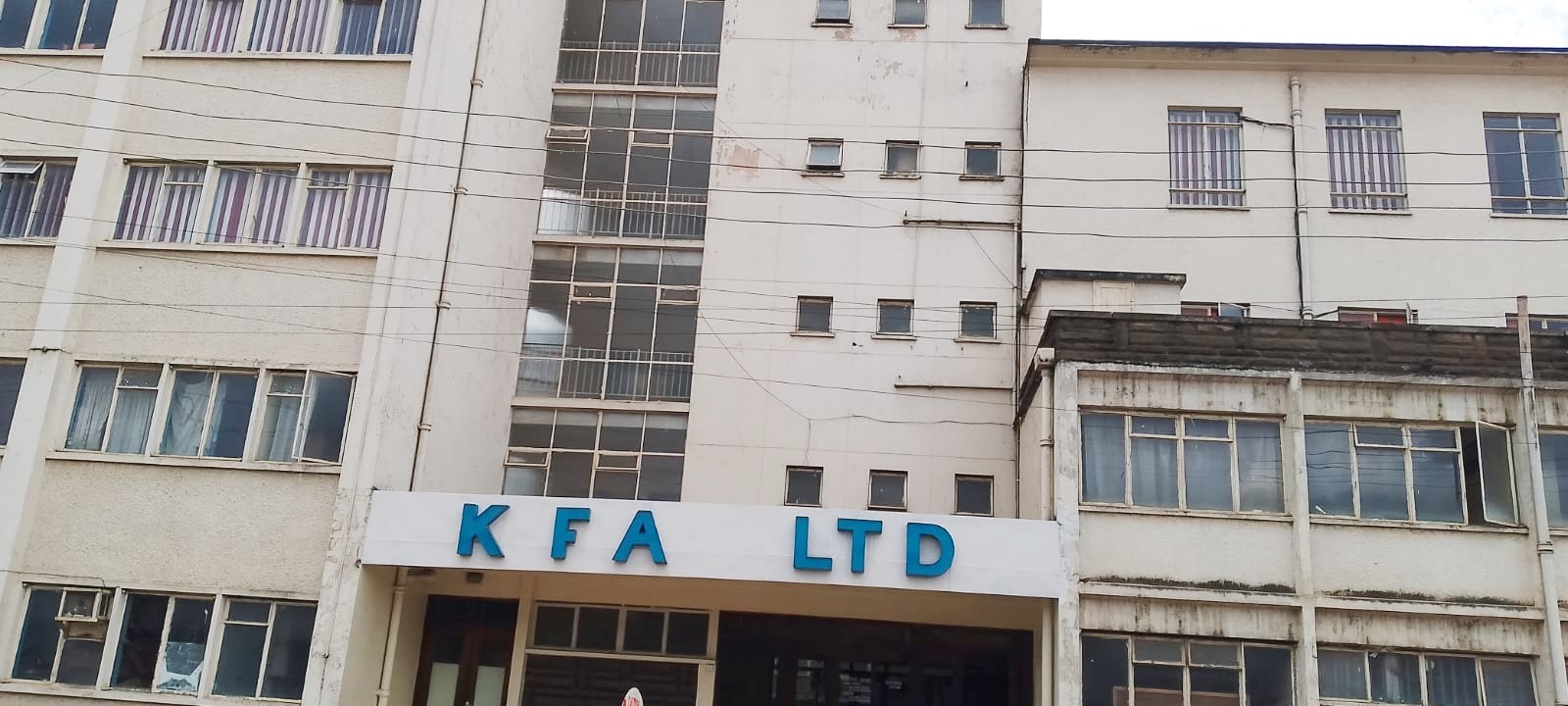
The Kenya Farmers’ Association (KFA) building, fondly known as KFA House, has witnessed nearly seven decades of history, resilience, and transformation.
Its story begins almost a century ago. Incorporated in 1923, the Kenya Farmers’ Association was created to serve farmers’ needs; marketing produce, supplying fertilisers, seeds, chemicals, and machinery. As agriculture expanded across the Rift Valley, KFA grew with it, establishing branches countrywide.
Read More
In 1957, the association built its multi‑storey headquarters in Nakuru. More than functional, the building symbolized prosperity and modernity, reflecting Nakuru’s role as a gateway to fertile farmlands and a hub of agricultural innovation.
For decades, farmers flocked to its offices to buy inputs, access credit, and conduct business. Commercial tenants filled its spaces, adding vibrancy to the CBD. By the late 1970s and 1980s, KFA House was the tallest building in Nakuru — a concrete beacon of progress.
But fortunes shifted. Political interference in the 1980s led to the temporary dissolution of the association. Though later restored, mismanagement and mounting debts weakened its stability.
By the 2010s, the Nakuru building once a proud symbol became entangled in legal and financial disputes. Banks sought to sell KFA assets, including the headquarters, to recover loans. Court battles delayed sales, but uncertainty lingered. For farmers and residents, the possible loss of KFA House meant more than financial collapse; it was the fading of a cooperative era that had shaped livelihoods and food security.
Despite these struggles, KFA House still stands. Its mid‑20th‑century design contrasts sharply with the glass towers now reshaping Nakuru’s skyline. Walking past it today, one is reminded of the city’s evolution, the ebb and flow of agricultural economies, and the enduring legacy of institutions that once defined a generation of farmers.
Discussions about reviving and restructuring KFA surface periodically, reflecting farmers’ desire to reclaim an institution that once served them well. Whether the Nakuru building continues as a commercial property, a heritage site, or a revitalised hub for agricultural services, it remains a silent witness to Kenya’s agricultural journey.
Driving into Nakuru along the Nakuru–Eldoret highway, the first sight that greets you is the KFA Roundabout — a bustling landmark near Naivas and KFC, anchoring the city’s gateway. The building is more than stone and steel; it is memory, possibility, and a testament to how institutions mirror the changing fortunes of a nation.
Stay connected with us on WhatsApp and Facebook for instant updates and breaking news as it happens.