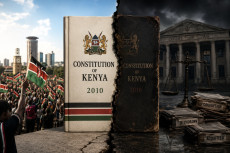
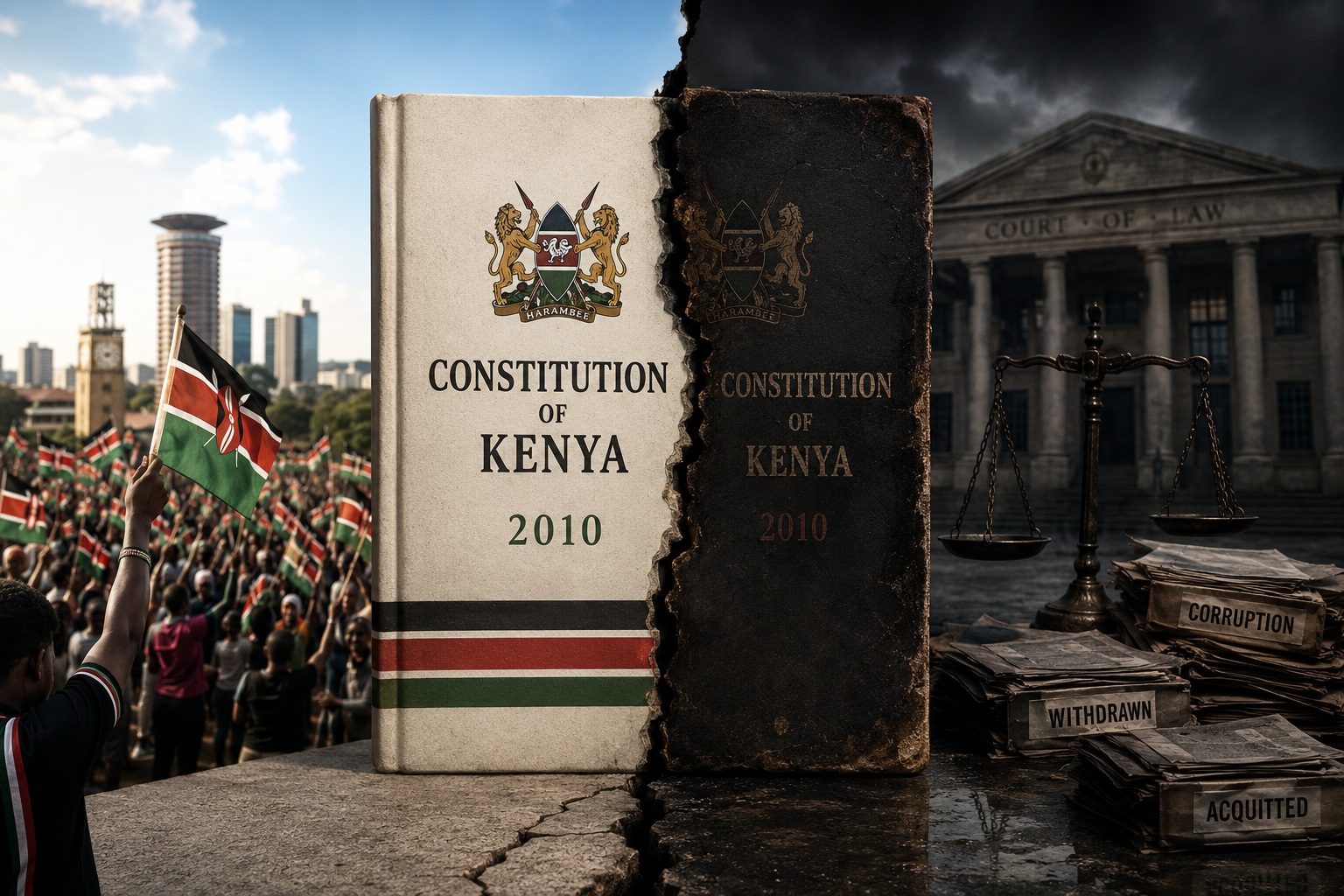
Sixteen years after the 2010 Constitution transformed Kenya’s legal and political order, its promises of equality, accountability, integrity and social justice remain under pressure. From corruption cases that collapse to citizens confronting state force, the gap between constitutional ideals and lived reality raises a difficult question: did Kenya write a Constitution it has been unwilling to fully live by?
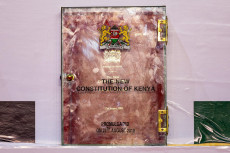
Sixteen years ago, on 27 August 2010, Kenyans packed Uhuru Park to witness the promulgation of a new Constitution. Grandmothers wept. For a nation scarred by the 2007–08 violence, that document was a covenant. Today, that covenant is quietly bleeding out in courtrooms across Nairobi.
What the Document Promised
Article 10 binds every State organ and public officer to integrity, transparency, accountability, equity and social justice — not merely as aspirations, but as national values and principles of governance.
Article 27 declares every person equal before the law, entitled to equal protection and equal benefit of the law, and prohibits discrimination on any ground.
Article 61 establishes that all land in Kenya belongs to the people of Kenya collectively. Article 60 requires that land be managed in an equitable, efficient, productive, and sustainable manner.
Read More
Article 201 requires that public finance be managed openly and accountably, with public money used prudently and responsibly, and financial burdens and benefits shared equitably. Article 203 provides for equitable sharing of nationally raised revenue and requires consideration of disparities between counties and the needs of marginalised areas.
Read together, they describe a country where a herder in Marsabit and a minister in Nairobi answer to one rulebook.
What Actually Happened
The record tells a more complicated story. Between 2022 and 2025, several of Kenya’s most high-profile corruption cases ended without the accountability many Kenyans expected.
Aisha Jumwa’s Ksh 19 million CDF-related corruption case was also terminated after the prosecution withdrew the charges this was one amongst many.
Most damning was the Arror and Kimwarer dams case. The prosecution alleged losses running into tens of billions of shillings, but called only eight of its intended forty-nine witnesses before the case ended in acquittals.
The KEMSA procurement scandal during the Covid-19 period produced investigations and hearings, but the broader question of political accountability remained unresolved.
Together, these cases are few of many that expose the human cost of failing to uphold the principles of public finance and accountability that the Constitution was designed to protect.
Money meant for public development cannot be used for private gain without undermining the very idea of equitable government.
Why It Cuts So Deep
Kenyans are not naive about corruption. What wounds is the arithmetic.
Article 29 guarantees freedom and security of the person, including protection from arbitrary detention and violence. Article 37 protects the right to assemble, demonstrate, picket and present petitions peacefully and unarmed. Article 33 protects freedom of expression, including the freedom to seek, receive or impart information and ideas.
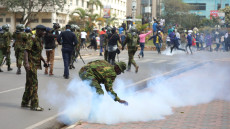
Yet citizens exercising those rights have at times faced tear gas, arrests and other forms of state force, while high-profile corruption cases have ended in withdrawals, acquittals or prolonged proceedings.
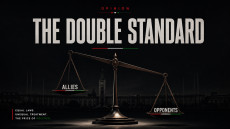
A hawker in Gikomba can be arrested for obstruction. A boda boda rider can be fined for a missing helmet. A powerful public figure can spend years contesting allegations in court.
When Ferdinand Waititu was finally jailed, the surprise was not simply the convictions. It was that the system had carried a major corruption case through to its conclusion.
The problem has not been confined to politicians or the executive. The judiciary and other public institutions have also faced serious integrity challenges. Judges Said Chitembwe and Joseph Mutava were removed from office following findings of gross misconduct.
The lesson is uncomfortable: institutional independence cannot mean institutional impunity. The people entrusted with enforcing the Constitution must also be accountable to it.
How Kenya Recovers
Kenya does not necessarily need a new Constitution. It needs to make the existing one work.
It needs prosecutors who build and finish cases, investigators whose work can withstand scrutiny, an EACC that can operate without political interference, and courts that do not allow delay to become a substitute for justice.
It also means taking the constitutional principles of leadership and integrity seriously — treating public office as a public trust rather than a shield against accountability.
The Constitution did not promise Kenyans a perfect country. It promised them a country in which power would be subject to law. Sixteen years later, the challenge is no longer what Kenya wrote into its Constitution. It is a matter of whether the country will live by it.
Until a Cabinet Secretary faces the same law as a mama mboga, Article 27 risks remaining beautiful writing on cheap paper.