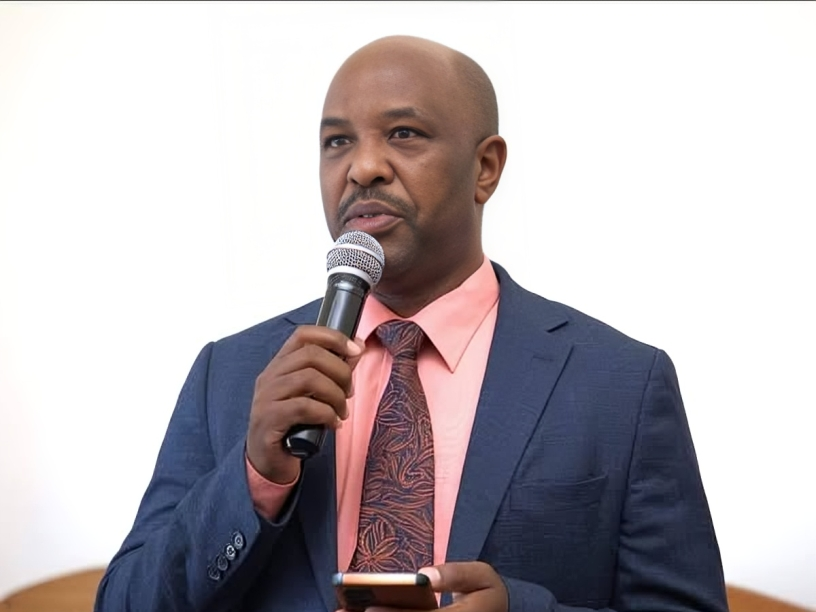
- Speaking on March 26, 2026, during the issuance of cheques to cooperative societies under the National Agricultural Value Chain Development Programme (NAVCDP) at ATC Soilo, Mwangi emphasized the need for proper resource allocation.
The Member of County Assembly for Menengai East Ward, and aspiring Member of Parliament (MP) for Nakuru Town East Wilson Mwangi, has urged the Nakuru County Government to raise agriculture’s share of the budget to 20 percent, arguing that such an increase would directly benefit farmers through stronger food security, better nutrition, improved health, and fewer diseases.
Speaking on March 26, 2026, during the issuance of cheques to cooperative societies under the National Agricultural Value Chain Development Programme (NAVCDP) at Nakuru Agricultural Training Centre (ATC) Soilo, Mwangi emphasized the need for proper resource allocation.
“As a county, we should allocate resources properly to farmers so they can produce effectively,” he said.
Mwangi singled out pyrethrum as a crop deserving greater investment. He noted that the President has already reached out to Europe and America to secure new export markets, and Nakuru farmers historically leaders in pyrethrum production, stand to benefit once those markets open.
He urged the county to channel more funds into pyrethrum farming so farmers can scale up production and tap into new opportunities.
Read More
Beyond exports, Mwangi highlighted pyrethrum’s broader value. The crop can be processed into medicines and insecticides, adding industrial and health benefits.
“Dear farmers, don’t abandon pyrethrum. We once led the nation in this crop. Today, reliance on synthetic fertilizers is contributing to rising cancer cases. Let’s return to pyrethrum and reclaim its value,” he appealed.
Pyrethrum: Nakuru’s “White Gold”
Pyrethrum, often called Kenya’s white gold, was once the backbone of rural economies in Molo, Kuresoi, Njoro, and Gilgil. Introduced in the late 1920s, the daisy-like flower positioned Kenya as a global leader in natural insecticide production.
By the 1990s, Kenya produced over 80 percent of the world’s pyrethrum, with Nakuru serving as the industrial hub through the Pyrethrum Processing Company of Kenya (PPCK).
Smallholder farmers relied on pyrethrum for school fees and household income, making it a cornerstone of rural livelihoods. But the industry collapsed in the late 1990s and early 2000s due to poor pricing, mismanagement, corruption at the Pyrethrum Board of Kenya, delayed payments, and competition from synthetic insecticides.
Revival Efforts Underway
Nakuru County Government has reaffirmed pyrethrum’s strategic importance, noting its role in providing raw materials for industrial and manufacturing processes. In 2025, the Agriculture and Food Authority’s Miraa, Pyrethrum, Fibre and Other Industrial Crops Directorate held capacity-building training for county extension officers, strengthening their ability to support farmers across the value chain.
The revival strategy builds on a capacity needs assessment in Narok, Kisii, Nyamira, Nakuru, and Nyandarua counties.
Agriculture County Executive Committee Member (CECM) Leonard Bor stressed that collaboration now focuses on science-backed solutions to empower farmers, improve service delivery, and revitalize the industry for long-term sustainability.
National policy has also shifted in pyrethrum’s favor. In May 2025, Agriculture and Livestock Development Cabinet Secretary (CS) Mutahi Kagwe announced a ban on more than 50 harmful pesticide brands and positioned pyrethrum as a safer, natural alternative.
The government now views pyrethrum as a strategic crop to replace banned synthetic pesticides and align Kenya with global demand for eco-friendly solutions.
While revival efforts are underway, many farmers still prefer faster, more profitable crops like potatoes and maize.
Stay connected with us on WhatsApp and Facebook for instant updates and breaking news as it happens