The benefits include thousands of jobs, new skills for local workers, steady tax revenue for schools and roads, lower public debt, reliable power for homes and factories, and exports of surplus clean energy. Families cook cleaner, businesses avoid blackouts, and rural areas gain light and growth.
Kenya is moving to expand electricity access to universal coverage by 2030, achieve 100 percent clean cooking, raise its clean energy share to full reliance and modernise the grid for regional power trade.
It also aims to accelerate e‑mobility and green industries through special economic zones such as KenGen Green Energy Park and Dongo Kundu.
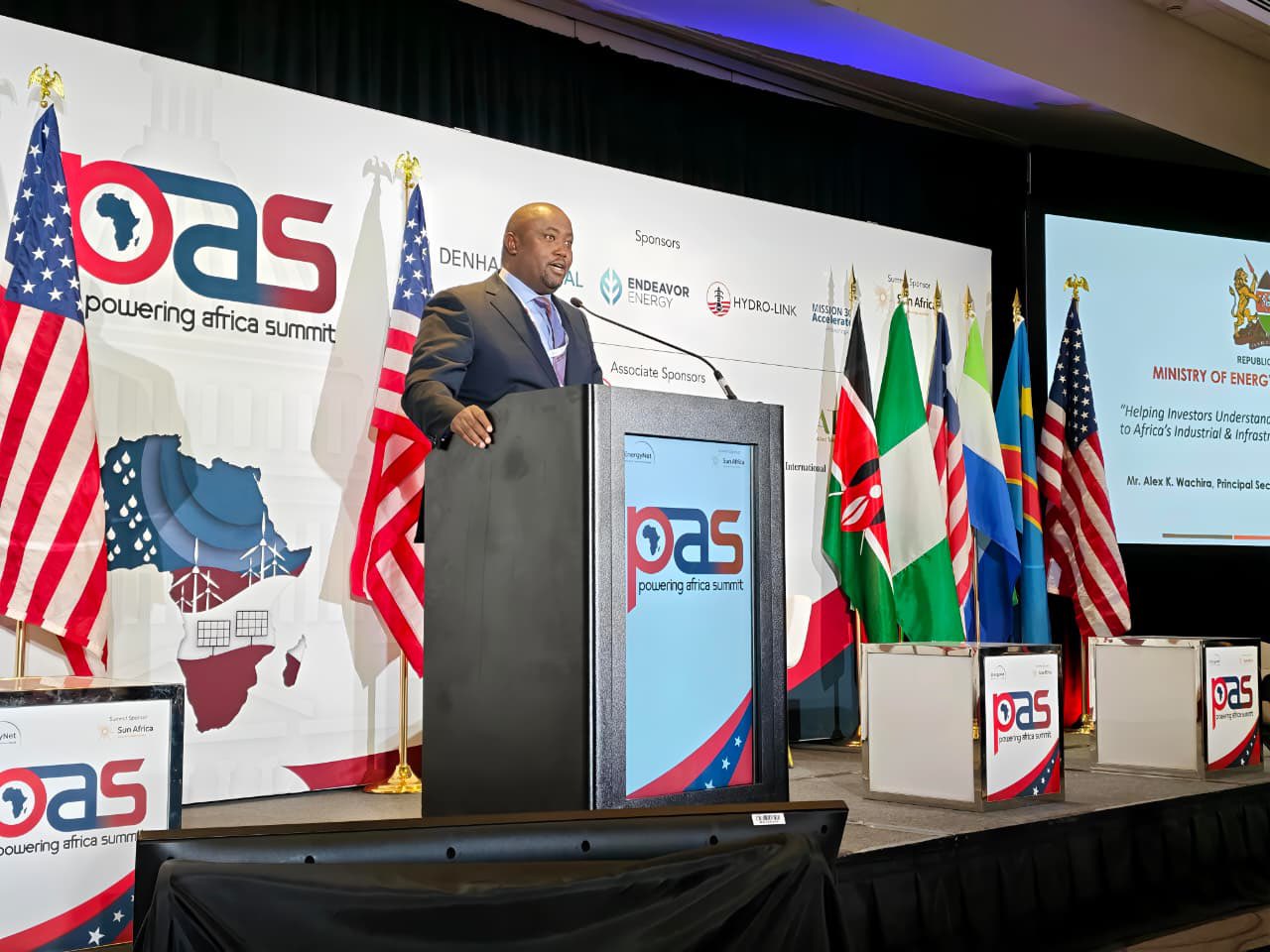
The Principal Secretary (PS) for Energy Alex Wachira outlined these commitments during the Powering Africa Summit (PAS2026) at the W Marriott in Washington, D.C., held on March 19–20, 2026. The summit focused on strengthening energy partnerships between the United States and Africa.
“I noted the deliberate actions we have taken as a government to deliver reliable, affordable, sustainable, inclusive, and clean energy for all Kenyans,” Wachira said in his keynote, later shared on X.
He emphasized that the government continues to modernize the national transmission grid, leveraging regional interconnectivity and power trade through the Eastern Africa Power Pool. “This is ongoing through government and development‑funded projects,” he added.
Read More
U.S. Secretary of Energy Chris Wright, who opened PAS2026, underscored urgency: “Move fast and act now—not statements, not intentions.”
His call framed discussions on U.S.–Kenya energy cooperation in nuclear power development, progress on 123 Agreements, and expanded collaboration in geothermal, LPG‑to‑power, battery storage, clean cooking, and data centres.
Western Kenya Development Tour
Kenya’s energy vision is already taking shape on the ground. In March 2026, President William Ruto conducted a five‑day development tour across Western Kenya, commissioning multi‑billion shilling projects aimed at achieving universal electricity access by 2030.
These initiatives target rural households and small businesses through grid expansion and localized solar solutions.
In Kakamega County, he launched the Nderema Village Electrification Project in Navakholo, costing KSh 12.6 million to connect an initial 161 homes. This forms part of a larger KSh 2.37 billion plan to connect over 36,700 households.
In Bungoma County, he flagged off a KSh 1.8 billion program in Cheptais, Mt. Elgon, targeting more than 25,800 households.
In Vihiga and Busia Counties, he rolled out additional projects under the broader KSh 6.3 billion regional push to connect nearly 89,000 new customers.
Private Sector Role
Wachira stressed that private investors remain central to Kenya’s energy transformation. They bring advanced technology, faster delivery, and capital beyond government means.
The benefits include thousands of jobs, new skills for local workers, steady tax revenue for schools and roads, lower public debt, reliable power for homes and factories, and exports of surplus clean energy. Families cook cleaner, businesses avoid blackouts, and rural areas gain light and growth.
Stay connected with us on WhatsApp and Facebook for instant updates and breaking news as it happens.