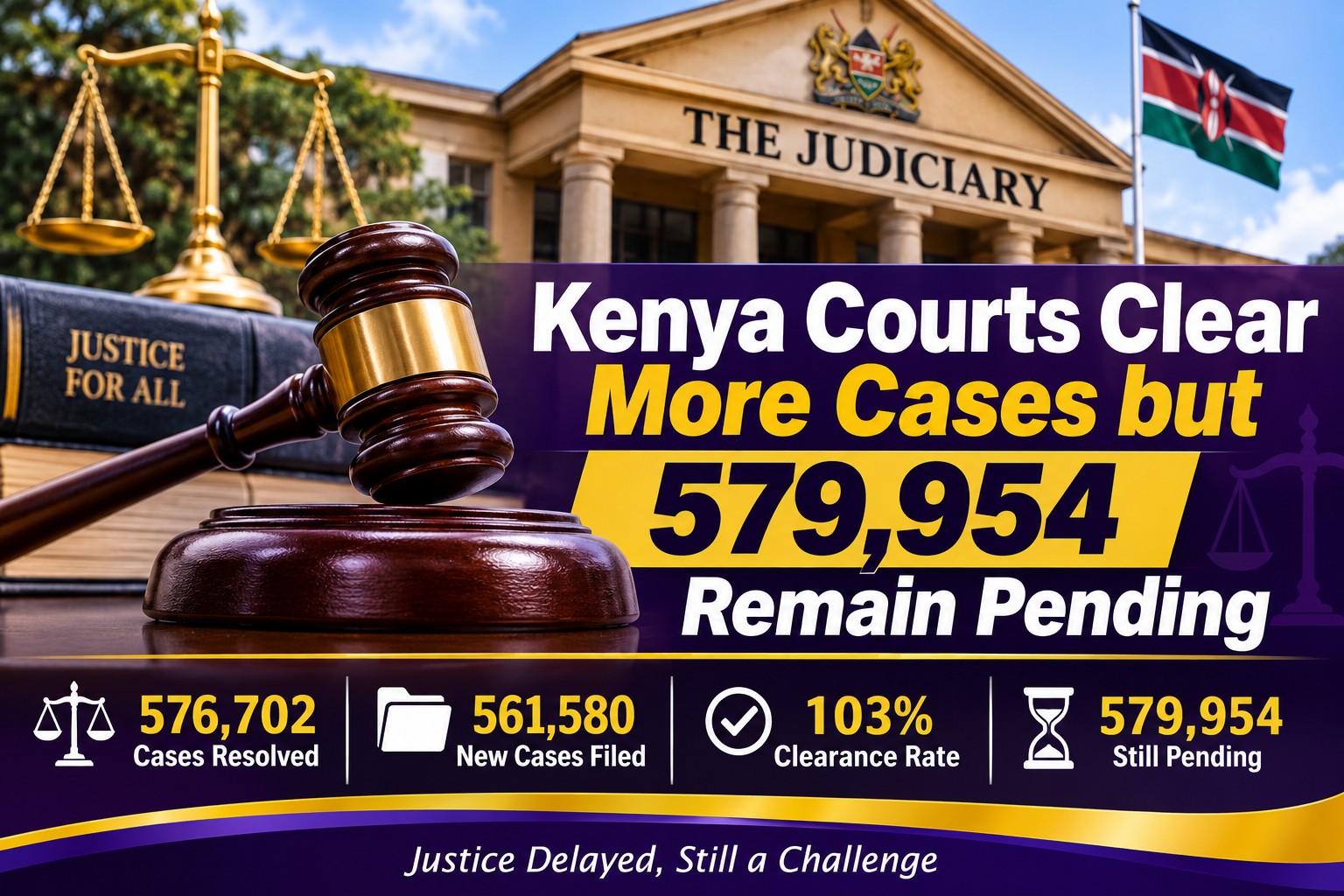
Kenya’s Judiciary resolved 576,702 cases against 561,580 new filings in the 2025/26 financial year, achieving a 103 per cent clearance rate. Despite the improved performance and a two per cent reduction in the overall caseload, 579,954 cases remained pending by June 2026, with thousands of disputes, particularly land cases, having lasted more than
The Judiciary recorded a 103 per cent clearance rate in the 2025/26 financial year. The figures show progress in reducing the caseload, alongside persistent delays in some areas.
A case may end with a judgment, a ruling or a settlement. But for hundreds of thousands of people whose disputes remain before Kenya’s courts, the wait continues.
That is the picture in the Judiciary’s performance report for the 2025/26 financial year: courts concluded more cases than they received, yet closed the year with 579,954 matters still pending.
The State of the Judiciary and the Administration of Justice Report says courts received 561,580 new cases and resolved 576,702, giving the Judiciary a clearance rate of 103 per cent. It was the second consecutive year in which concluded cases outnumbered new filings. The total caseload fell by two per cent, from 595,076 in June 2025 to 579,954 a year later.
The trend points to progress. But the national clearance rate is only one measure of how justice is experienced. The number of cases still waiting—and how long they have waited—offers another.
Read More
Where the backlog sits
Magistrates’ courts handled the largest share of new cases, receiving 389,952 during the year. They resolved 395,130. In civil matters, they concluded 157,088 cases against 144,540 received. In criminal matters, they resolved 238,042 against 245,412 new cases.
The High Court received 48,437 cases: 17,383 criminal and 31,054 civil. Its pending caseload, however, stood at 69,239. Civil appeals accounted for the largest share, followed by probate and administration cases, miscellaneous applications, murder cases and criminal appeals.
The figures capture the scale of work moving through the courts, but also the volume still waiting for attention. A national clearance rate cannot show how long an individual litigant has waited, or what a delayed ruling means for a family, a business or an accused person.
Disputes that take years
The Environment and Land Court received 10,531 cases and resolved 9,369. It ended the year with 11,942 pending cases. Of these, 7,009 had been in court for more than three years.
That older caseload is a reminder that resolving more cases than are filed in a single year does not automatically clear long-running disputes. The Judiciary’s report identifies Meru, Kiambu, Nakuru, Kakamega, Milimani and Murang’a among the High Court stations with the highest numbers of pending murder cases.
At the country’s highest levels, the Supreme Court delivered 92 bench determinations, including judgments, rulings and resolutions. The Court of Appeal recorded 2,894 determinations across its ten stations.
The Judiciary attributes the improved performance to case-management interventions and sustained performance monitoring, as well as the work of judges, judicial officers and staff. The report’s numbers provide evidence of higher output and a shrinking overall caseload. They also make clear that the workload remains substantial, and progress is uneven across case types.
For the person whose case has been concluded, a court’s decision may bring an end to uncertainty. For those still waiting, the key measure is not the national percentage but how soon their own matter will be heard and resolved.