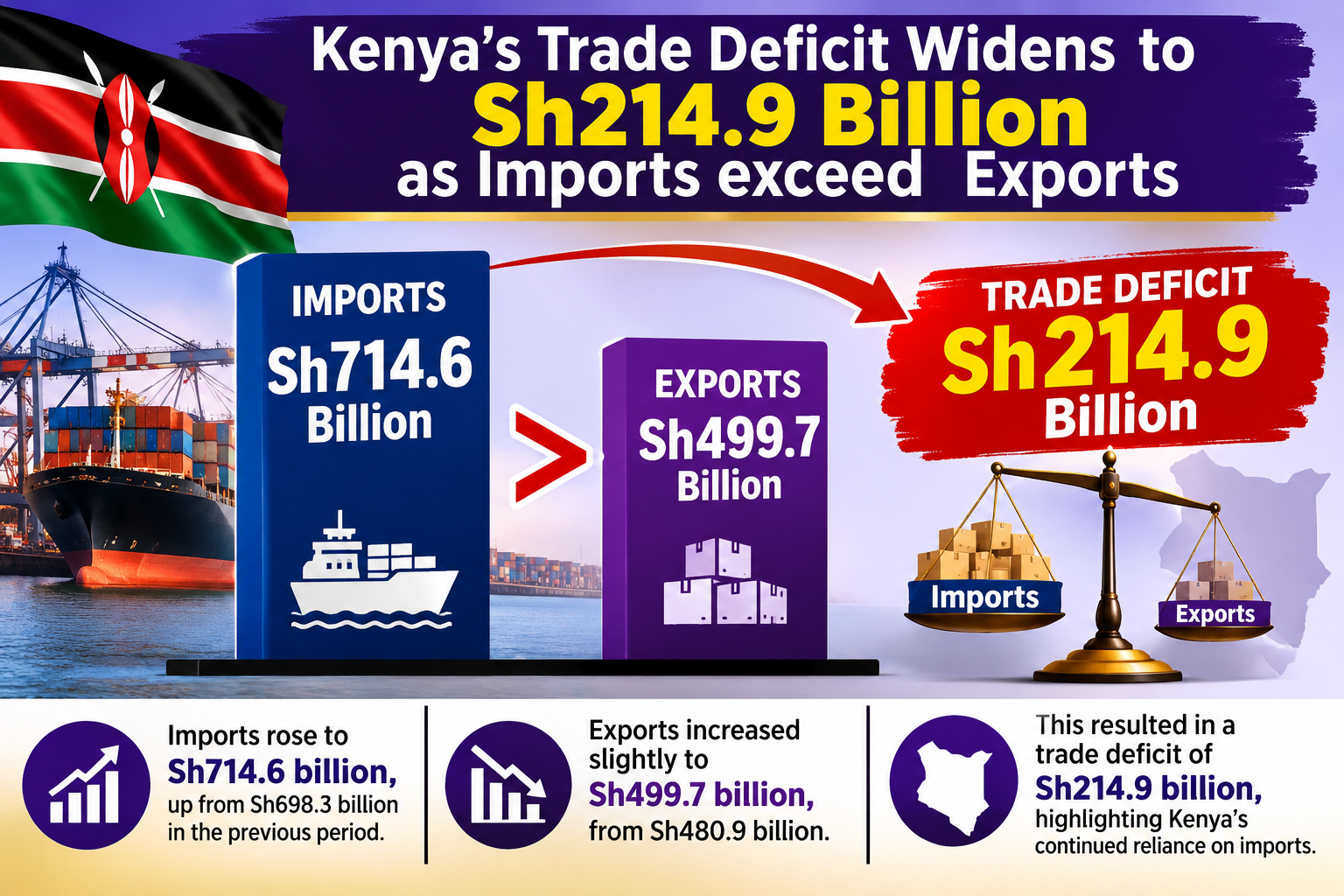
Kenya's merchandise trade deficit increased by approximately 28.9 per cent between August and September 2026. Imports rose to Sh344.2 billion, while exports reached Sh129.2 billion. China remained Kenya's largest source of imports, while the United States emerged as its leading export destination. The figures highlight the country's growing import expenditure and the importance of strengthening local production and export capacity.
Kenya's Trade Deficit Widens to Sh214.9 Billion as Imports Outpace Exports
Kenya's trade deficit widened to Sh214.9 billion in September 2026, compared to Sh166.7 billion recorded in August, as the country's expenditure on imported goods increased faster than its export earnings.
According to the Kenya National Bureau of Statistics (KNBS) September 2026 Leading Economic Indicators report, the value of imported goods increased from Sh284.8 billion in August to Sh344.2 billion in September, representing a 20.9 per cent rise.
During the same period, exports increased from Sh118 billion to Sh129.2 billion, representing a 9.5 per cent growth.
The difference between the country's import expenditure and export earnings resulted in a Sh48.2 billion increase in the monthly trade deficit.
China remained Kenya's largest source of imports, supplying goods worth Sh113.2 billion in September, followed by India at Sh51.8 billion and the United States at Sh21.9 billion.
Imports from China increased by 35.9 per cent compared to the previous month, reflecting the country's continued importance as a major trading partner.
On the export side, the United States emerged as Kenya's leading destination, receiving goods worth Sh27.9 billion. Uganda followed with exports valued at Sh13.2 billion, while Pakistan accounted for Sh6.4 billion.
Food and beverages contributed the largest share of domestic exports at 36 per cent, followed by machinery and capital equipment at 22.9 per cent.
The widening trade deficit raises concerns about Kenya's dependence on imported products and the country's ability to expand local manufacturing and production.
Economists generally consider sustained export growth important in strengthening foreign exchange earnings and improving a country's external trade position.
The latest figures highlight the need for policies that encourage local industries, support manufacturers and expand Kenya's access to international markets.