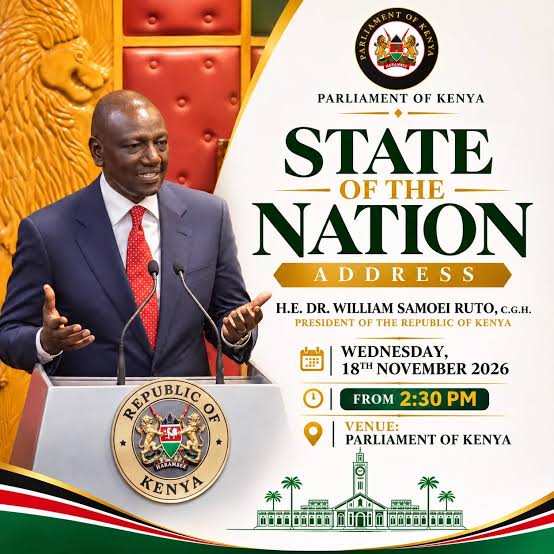
President William Ruto has outlined his administration's economic achievements and development priorities during his fourth State of the Nation Address, delivered on November 18, 2026, before a joint sitting of Parliament. He highlighted the KSh 340 billion National Infrastructure Fund, a KSh 5 trillion infrastructure investment plan, tax relief proposals, agricultural growth, job creation, affordable housing and expanded healthcare coverage. The President also cited progress in education, energy and economic stability while presenting his vision for Kenya's future ahead of the 2027 General Election. However, his administration's record continues to face scrutiny over the cost of living, unemployment and governance concerns.
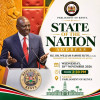
President William Ruto delivered Kenya's 2026 State of the Nation Address before a joint sitting of the National Assembly and the Senate on Wednesday, November 18, 2026, marking his fourth annual address under Article 132 of the Constitution.
In the address the President highlighted the following;
NATIONAL INFRASTRUCTURE FUND
President William Ruto addressed the National Infrastructure Fund Act, 2026 (Act No. 4 of 2026) during his State of the Nation Address on November 18, 2026, reporting that the Fund has been capitalized with KSh 340 billion and forms part of a broader KSh 5 trillion 10-year infrastructure financing plan.
ECONOMIC AND SOCIAL PRIORITIES
Macroeconomic Stability & Tax Relief: LMacroeconomic Stability & Tax Relief: Lowering the cost of essential goods while raising household incomes. Ruto cited inflation dropping from 9.6% in 2022 to 4.1% in 2025, the shilling stabilizing around KSh 129 per US dollar, and proposed exempting workers earning KSh 32,333 ($250) or less per month from income tax.
Infrastructure & Energy Expansion: Mobilizing roughly KSh 5 trillion ($38 billion) over the next decade—building on KSh 340 billion ($2.6 billion) raised for a National Infrastructure Fund—to expand power generation by 10,000 megawatts and upgrade roads, railways, ports, airports, and pipelines.
Agriculture and food security: Boosting farm productivity and incomes through subsidized fertilizer (reportedly cut from KSh 7,500 to KSh 2,000 per 50 kg bag), expanded irrigation, and value addition. Maize output was reported to have risen from 44.3 million bags in 2022 to 71 million bags.
Job Creation & Enterprise: Generating employment across affordable housing, manufacturing, the digital economy, and international labor markets, alongside support for MSMEs and youth programs.
Universal Healthcare: Expanding coverage and reducing out-of-pocket medical costs through the Social Health Authority (SHA), which was reported to have registered 33.7 million Kenyans.
Education & Skills: Strengthening teaching capacity and learning facilities, including employing 100,000 teachers over four years with plans to recruit 20,000 more, alongside TVET and university financing reforms.
Affordable Housing & Equity: Moving households from informal settlements into permanent homes and advancing inclusive development under the principle of Usawa ni Sawa ("equity is equality").
POLITICAL CONTEXT AND REACTION
Pre-2027 Positioning: Delivered four years into Ruto's first term, the speech served as both a stock-taking report and a pitch for re-election ahead of 2027.
Economic & Governance Debates: Ruto framed his record around the Bottom-Up Economic Transformation Agenda and the principle of Usawa, citing falling inflation, shilling stability, Social Health Authority (SHA) registrations, housing, and infrastructure. At the same time, opposition figures and civil society pointed to ongoing cost-of-living pressures, youth unemployment, protest fallout, and constitutional disputes.
Future Vision: Ruto highlighted plans for a national conversation on Kenya's direction beyond Vision 2030 and urged lawmakers to advance seven education bills.

-1774423691-md.jpg)


-1774423691-sm.jpg)