- The charter is designed to remove uncertainties by clearly distinguishing between government-funded services and those requiring out-of-pocket payment or insurance coverage.
For years, patients entering public hospitals have silently asked themselves: “What is truly free, and what will I be asked to pay for?”
What should be a place of healing has too often become a place of anxiety, with confusion at service points, unforeseen fees, and ambiguous policies clouding the experience of care.
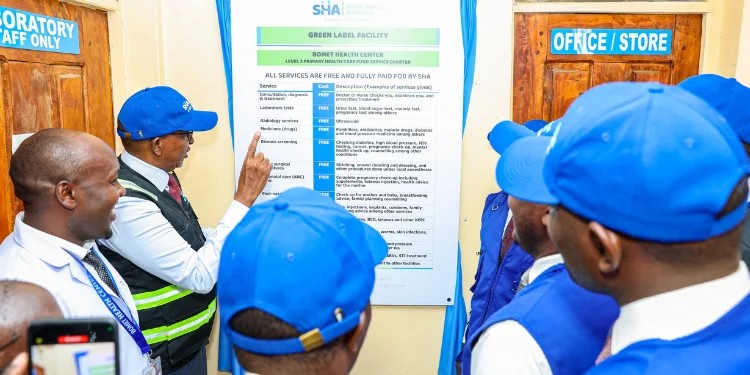
Now, the health sector has announced a bold step to end that uncertainty. Hospitals will prominently display a #GreenLabelCharter—a clear, visible guide detailing all government-funded healthcare services.
This marks a significant shift in Kenya’s public health system toward accountability, transparency, and patient empowerment.
Health Cabinet Secretary Aden Duale explains that the charter is a visible notice placed at Level 2, Level 3, and selected Level 4 facilities, serving as a public commitment that certain services are free of charge.
Read More
“Hospitals must provide all designated free services—laboratory tests, diagnostics, doctor consultations, immunizations, HIV testing, and essential medicines—at no cost to patients. In addition, every Kenyan will now receive an SMS after visiting a hospital for primary health care, ensuring transparency and accountability,” said Duale.
According to health officials, the charter is designed to remove uncertainties by clearly distinguishing between government-funded services and those requiring out-of-pocket payment or insurance coverage.
Patients will be able to quickly identify services available at no cost, including vital diagnostics, maternal health services, and immunizations.
This clarity could transform the lives of many Kenyans, particularly those from low-income households.
Public hospitals are often the first point of care, yet unclear billing has historically deterred patients from seeking treatment promptly.
By prominently showcasing free services, the Green Label Charter seeks to ease financial anxiety and rebuild trust in the public health system.
Beyond patient awareness, the program also strengthens hospital accountability. Clear public information reduces the risk of misinformation, unofficial charges, and miscommunication between patients and healthcare providers.
It establishes a common point of reference that both service users and providers can rely on.
Health leaders note that the charter aligns with broader reforms aimed at achieving Universal Health Coverage (UHC).
They emphasize that transparency must go hand in hand with funding and infrastructure—because even well-financed services can fail if communication is unclear.
Hospitals are required to display the Green Label Charter in conspicuous locations such as waiting areas, outpatient departments, and entrances.
Some facilities are expected to adopt digital versions to reach more patients, including those with visual impairments or language barriers.
As the charter expands nationwide, it offers both assurance and information. It signals to families seeking care, emergency patients, and expectant mothers that the system is striving to be transparent, equitable, and people-centered.
The Green Label Charter introduces a new dimension to public healthcare—one that embodies clarity, dignity, and the fundamental right to know.
In a field where trust can determine whether treatment is sought or delayed, this charter carries profound importance.
Stay connected with us on WhatsApp and Facebook for instant updates and breaking news as it happens.