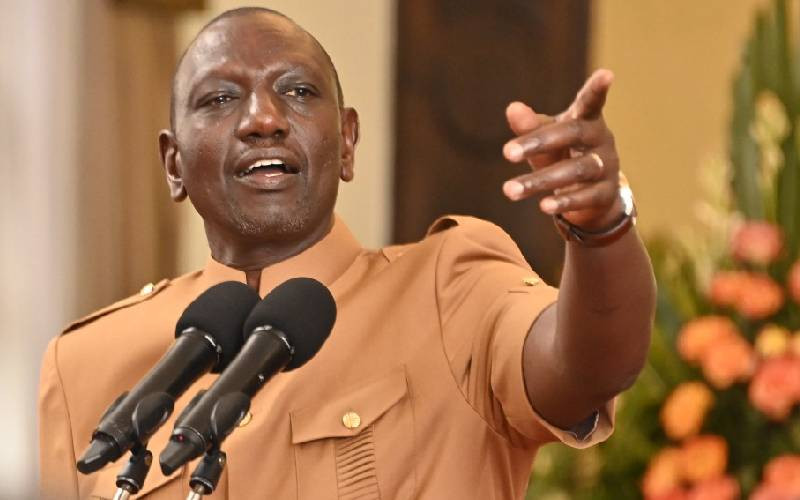
- According to the President, the government has already allocated substantial funding to support education, and he insists that no child should be excluded from school because of poverty.
President William Ruto has issued a directive to all public schools to admit Grade 10 learners immediately, whether or not they have paid school fees or acquired the prescribed senior secondary school uniform.
The order was delivered in Meru on January 22, 2026 during the Nyota Capital Disbursement event.
According to the President, the government has already allocated substantial funding to support education, and he insists that no child should be excluded from school because of poverty.
“No child in Kenya should remain at home because of lacking a uniform. No child should remain at home because they do not have school fees, since we have sent Ksh 44 billion for educating our children,” the President declared.
The directive comes amid growing concern that thousands of learners who successfully transitioned from junior secondary have not reported to their designated senior schools due to financial strain.
Read More
Ruto has emphasized that poverty or logistical hurdles must not deny any child the right to education. He instructed school heads, education officials, and grassroots administrators to ensure all eligible learners are admitted without delay, cautioning against practices that lock out students over unpaid fees or uniforms.
Under the new policy, learners will be allowed to temporarily continue wearing their junior secondary uniforms as parents and guardians make arrangements for senior school requirements. The President stressed that uniforms should never become an obstacle to learning, particularly at the early stages of implementing a new education structure.
The admission of Grade 10 learners marks a historic milestone in Kenya’s education reforms—the first full transition into the senior secondary phase of the CBC. At this level, students begin to pursue specialized learning pathways in science and technology, arts, and sports, signaling a departure from the one-size-fits-all model of the former 8-4-4 system.
Sector data shows that while reporting rates have been relatively strong in national and extra-county schools, several county and sub-county institutions have recorded lower enrolment. Financial pressure on households—particularly the combined cost of boarding fees and new uniforms—has been identified as a key factor behind delayed reporting.
Education Cabinet Secretary Ogamba noted that families struggling with costs, parents transferring children to other schools, and delays in admission windows are among the reasons the transition rate has yet to hit 100 percent.
To cushion families, the government has released first-term funding to schools and reaffirmed its commitment to free and subsidized education at the senior secondary level. Officials have warned public schools against imposing unauthorized levies, stressing that government support mechanisms are designed to ease the burden during this transition.
The Ministry of Education has also launched a nationwide mop-up exercise to trace learners who have not reported. Chiefs, assistant chiefs, and grassroots administrators have been tasked with identifying affected students and facilitating their admission—an approach that signals a whole-of-government effort to achieve full transition.
Stay connected with us on WhatsApp and Facebook for instant updates and breaking news as it happens.