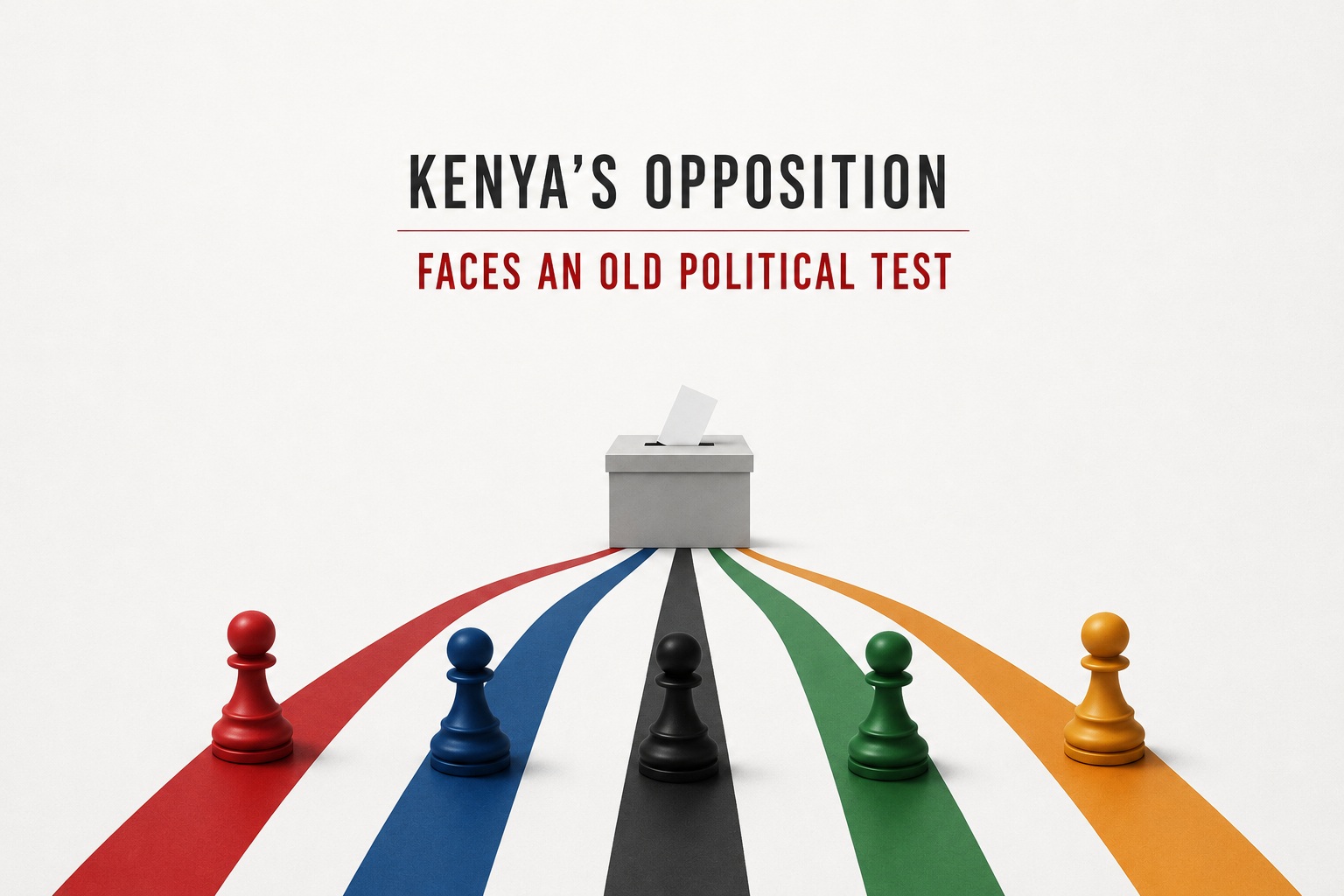
Kenya’s return to multiparty politics was meant to widen democratic choice, but the country’s electoral history also shows how fragmented opposition forces can struggle to convert popular support into political power. As Rigathi Gachagua argues for strong individual parties while simultaneously calling for a united opposition, the country is once again confronting the difficult balance between political competition, organisation and collective action.
Political parties can organize competition. They cannot, by themselves, deliver change.
Political parties are supposed to make democracy work. They bring shared interests together, build political platforms, mobilize voters and give citizens clearer choices at the ballot box. But Kenya’s experience tells a more complicated story.
The return to multiparty politics in the early 1990s, and the latest debate among opposition leaders, show that having many parties can either strengthen or weaken the opposition. The difference lies in whether those parties can eventually work together.
What Political Parties Are Meant to Do
At their most basic, parties are organized groups that compete in elections to gain and exercise political power. Edmund Burke captured this practical role in 1770 when he described a party as a body of men united to promote the national interest according to a shared principle.
Read More
American political scientist E.E. Schattschneider later argued that modern democracy is almost unthinkable without political parties. Jurist Hans Kelsen went further, viewing parties as essential because they turn free association into collective political will.
That is what parties are meant to do in practice: gather scattered opinions, give political conflict structure, offer voters recognizable choices and connect ordinary citizens to the state. Their importance, therefore, is not simply in how many exist. It is in how effectively they perform those functions.
Kenya’s Hard Lesson from the 1990s
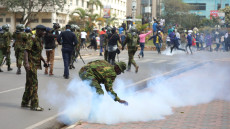
Kenya learnt this lesson the hard way after the end of one-party rule. In December 1991, President Daniel Arap Moi’s government repealed Section 2A of the Constitution and restored multiparty politics after years of KANU dominance.
Many expected the move to open the door to a genuine transfer of power. Instead, the sudden emergence of several opposition parties helped Moi stay in power.
In the December 1992 presidential election, the opposition vote fractured along ethnic and personality lines. Kenneth Matiba of FORD-Asili, Mwai Kibaki of the Democratic Party, and Jaramogi Oginga Odinga of FORD-Kenya each commanded significant support.
Moi won with roughly 36–37 per cent of the vote — nowhere close to a majority, but enough under the first-past-the-post system then in place.
The pattern repeated itself in 1997. The large number of parties allowed the incumbent to preserve his regional base while his rivals divided the rest of the vote and cancelled one another out. Most analysts agree that a single, unified opposition candidate in either election would likely have produced a different result.
The Old Problem Returns in 2026
That old problem has now returned in a new form.
On 5 August 2026, Democracy for Citizens Party leader Rigathi Gachagua rejected claims that he had asked smaller Mount Kenya opposition parties to dissolve and join his party. Speaking at his Wamunyoro home, he said he supports multiparty democracy and has never asked any leader to fold their party.
“I believe in many political parties because they will give us many agents,” he explained, arguing that multiple parties can strengthen the opposition’s presence on the ground. His message was that other leaders should first popularize and consolidate their own parties rather than rush into mergers.
6th August 2026, Gachagua went a step further, positioning himself as the leading contender for the united opposition’s presidential ticket ahead of the 2027 election.
Yet he also insisted that opposition leaders must “hunt as one pack” if they want to unseat President William Ruto. He compared them to hyenas, which can bring down larger prey by working together.
The Central Tension
There is an obvious tension here, but it is not necessarily a contradiction. Gachagua said there was no need to hurry in choosing a single flagbearer. He argued that parties must first consolidate their support bases before sitting down to negotiate a joint candidate.
And that brings Kenya’s old political dilemma into sharp focus.
Strong, independent parties can build organizational capacity. They can mobilize more voters, establish deeper structures and give their leaders greater leverage at the negotiating table.
But if those parties never coordinate, the same strength can become a weakness. They can divide the opposition vote and make it easier for an incumbent to survive.
That is precisely what Kenya’s experience under Moi demonstrated. A crowded opposition field did not automatically produce political change. In some circumstances, it helped prevent it.
The Real Test Ahead of 2027
Gachagua’s current position raises the same question from the opposite direction. Can the opposition allow individual parties to grow, build their own support bases and strengthen their negotiating positions while still managing to unite when it matters most?
That may ultimately be the real test of Kenya’s opposition ahead of 2027.
The Wider Lesson
The wider lesson is straightforward. Political parties are necessary instruments of organized democratic competition. But numbers alone do not produce democratic change.
What matters is what parties do with their strength — whether they use it to build collective power or to advance individual ambition.
In the end, that choice can determine whether political parties strengthen the democratic process or frustrate it.