
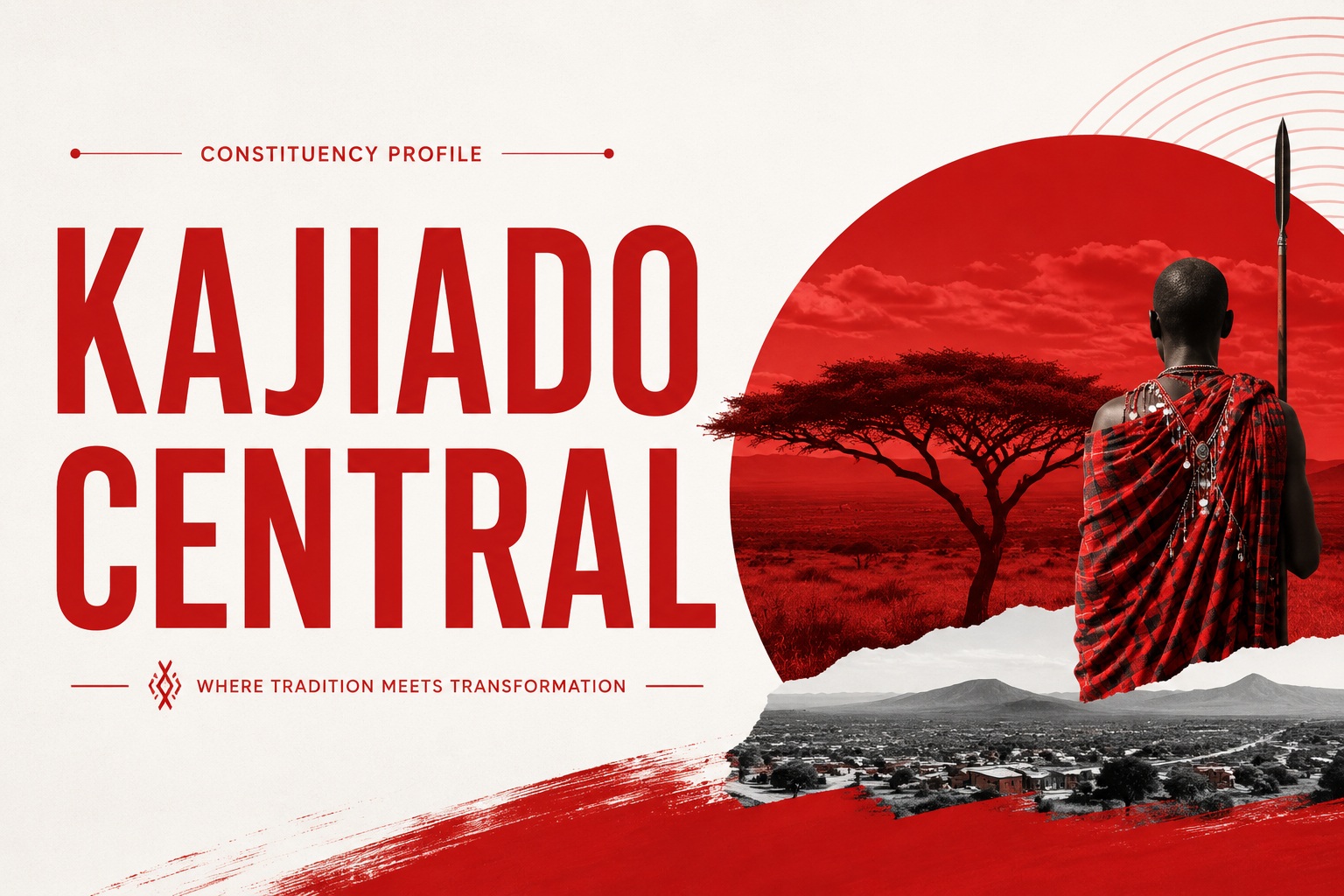
From vast grazing lands to a changing political landscape, Kajiado Central stands at the crossroads of tradition and transformation. The constituency’s Maasai identity, livestock economy and rising development needs continue to shape its leadership choices as the 2027 General Election approaches.

Straddling the vast plains of Kenya's Great Rift Valley, Kajiado Central is a unique territory where deep-rooted Maasai traditions seamlessly converge with modern civic progress. With a total number of 102,804 people according to the 2019 Population , it spans an expansive 4,249 square kilometers, the constituency acts as the administrative heartbeat of Kajiado County, anchored by its historic capital, Kajiado Town.
Political Landscape: 2013–2022
Voter turnout has remained generally strong, reflecting deep community engagement, though it fluctuates with national moods. The parliamentary seat has stayed in ODM hands since 2013, but the contest has tightened over time, signaling a more discerning electorate.
2013 General Election
Read More
Joseph Kasaine Ole Nkaissery (ODM) won with 17,590 votes. while the first runner-up Patrick Tutui (TNA) garnered 5,234 votes.
2015 By-election (after Nkaissery’s appointment as Cabinet Secretary for Interior)
Winner was Elijah Memusi Kanchory (ODM) with 16,008 votes. The First Runner-up Patrick Tutui (JAP) who received 15,508 votes. This razor-thin contest gave Memusi’s narrow victory notable significance beyond the constituency.
2017 General Election
The then incumbent Elijah Memusi Kanchory (ODM) emerged victorious 23,013 votes. His closest opponent Christopher Meibuko Koisikir (Jubilee) followed with 15,996 votes.
2022 General Election
Incumbent Hon. Elijah Memusi Kanchory (ODM) garnered 23,357 votes defeating the first runner-up Moses Birisha (Wiper) who got 22,877 votes. Other notable: Anthony Kiroken (UDA) — 4,562 votes. Turnout: ~51,449 votes from approximately 65,823 registered voters.
Economy and Infrastructure:
The primary source of income in Kajiado Central is livestock rearing, which is central to nomadic livelihoods. Cattle, sheep, and goats are raised in these open areas and contribute to local and regional markets through meat, milk, and skins.
These pastoral areas often face drought, but local people have adapted and found innovative ways to survive such hardships. These include
- Feedlots for keeping animals until they get fatter and fetch better prices,
- Cooperatively run women's enterprises that sell milk to schools and nearby areas,
- The expansion of value chains around skins, honey, and fodder.
The informal sectors are well represented in Kajiado Town itself, where there are various commercial activities and small farm enterprises, especially in areas with sufficient water.
Kajiado Central has become peri-urban in parts since it lies very close to Nairobi. Cultural tourism has been developed, showcasing Maasai beadwork and the narration of stories under the shade of acacia trees.
But the major persistent challenges include, from time to time, droughts, land division problems, and lack of roads and electricity.
With the joint effort of the government and partners, progress is underway. Boreholes, solar water solutions, last-mile connectivity, and road infrastructure are gradually turning hardship into success.
NG-CDF and Development Programs
As part of the National Government Constituencies Development Fund, NG-CDF channels most of its money into education and basic facilities, the pillars of any society that must be strong enough to withstand change.
Some of the significant projects undertaken have been:
- Massive bursary schemes to allow needy students to reach secondary level education, college and university
- Development of water infrastructure which has brought relief to many households
- Other projects have been electrification initiatives aimed at ensuring the continuous availability of energy to homes, schools and community service centers.
In addition, training at the grassroots level on climate adaptation, youth enterprises, women's enterprises, and livestock value addition was introduced.
The initiatives are laying the groundwork for a healthier, more environmentally friendly and resilient society.
Sociocultural Significance and Developmental Goals
Far from being just a geographical definition or an official political unit, Kajiado Central is a dynamic cultural environment where traditional Maasai life and modernity interweave. As a Key Biodiversity Area of global importance, it seeks to balance human activity with ecological conservation.
The constituency is now at an intersection of possibilities, including:
- The highest form of pastoralism modernization while ensuring that Maasai cultural heritage is preserved.
- Establishment of tourism and trade activities in such a way that they don't destroy the natural resources.
- Mobilizing and strengthening women and youth as the main engines of change at the community level.
The area has been identified in national-level plans as a potential hotspot for tourism development due to the availability of both natural and cultural attractions; therefore, the sector is expected to not only boost the local economy but also create more jobs.
Hence, with strong leadership and unity among different sections of society, Kajiado Central has great potential to turn its resources into tangible benefits for generations of Maasais to come.
Do you have updates & corrections about this constituency? If you have information that should be captured, or notice data that has changed or is inaccurately presented, kindly write to us at [email protected].

-1784380637-md.jpg)

-1784294612-md.png)


-1784380637-sm.jpg)

-1784294612-sm.png)